

Start from consistency, not volume
A client who posts twice a week, every week, almost always does better than one who posts daily for a month and then disappears. Audiences and platforms both reward a steady rhythm, and clients judge you on whether their feed looks looked-after. So the first question is not "how much?" but "how much can we keep up for a year?"
Set a number you are confident you can sustain, then raise it once the routine is running. Lowering a number a client has got used to is a harder conversation than raising one.
A starting point for each channel
These ranges are a starting point for a typical small or mid-sized business client, not a rule. Adjust them for each client using the questions in the next section.
| Channel | Typical starting point | What decides it |
|---|---|---|
| 1 to 3 posts a week | How much the client has to say about their work and their field. Fewer, more considered posts usually beat frequent thin ones. | |
| 2 to 4 posts a week | How local and community-driven the business is. Events, offers and news push this up. | |
| 2 to 4 posts a week | How visual the business is and how many good images it can supply or make. | |
| X | 3 to 7 posts a week | Whether the client's audience is actually on X. Short posts make higher volume realistic. |
| 0 to 1 posts a week | Whether there are communities where the client can genuinely help. Many clients should not post there at all. | |
| Marketing email | 1 to 4 a month | How often the client has news or useful advice for people who opted in. |
| Blog | 1 to 4 a month | Whether the client wants to be found in search for questions their customers ask. |
For a small business working out its own posting rather than a client's, our guide on how often a small business should post covers the same question from the owner's side.
Five questions that set the number for each client
- Where is the audience? Two channels done well beat five done thinly. Drop channels where the client's customers are not.
- How much is there to say? A business with weekly offers, events or new stock has more to post than one with a single service that rarely changes. Do not invent news to hit a number.
- What can the client supply? Photos, quotes, case details and approvals all come from the client. If they reply slowly, plan a lower volume.
- What are they paying for? The number of posts is part of the agreement. Write it into the agreement per channel, so "more posts" is a priced change and not a favour.
- What does a campaign need? Launches and seasonal pushes raise volume for a few weeks. Plan them as a temporary change, then return to the normal rhythm.
Check that your roster fits your week
Once each client has a number, add them up. The calculation is simple:
- Posts per month = clients × channels × posts per channel per week × 52 ÷ 12.
- Hours per month = posts per month × minutes per post ÷ 60.
Use your own honest minutes per post, including finding the image, checking the facts and fixing the caption after the client's comments. Ten clients on three channels at three posts a week each is about 390 posts a month. At 20 minutes a post, that is about 130 hours, which is most of a full-time month before any client calls, reporting or invoicing.
If the hours do not fit, there are only three levers: fewer posts, fewer clients or less time per post. The content volume planner runs this calculation in your browser and shows how much time reviewing drafts could take instead of writing from scratch.
When to change a client's number
- Raise it when the client consistently has more worth saying than you post, and their audience is responding.
- Lower it when you are reaching for topics, approvals are slipping or the client's own engagement drops after more posts.
- Move it between channels when one channel clearly works and another does not. The total can stay the same.
- Review it every quarter. Put a date on it, rather than waiting for a client to ask.
How Zentivue uses the number
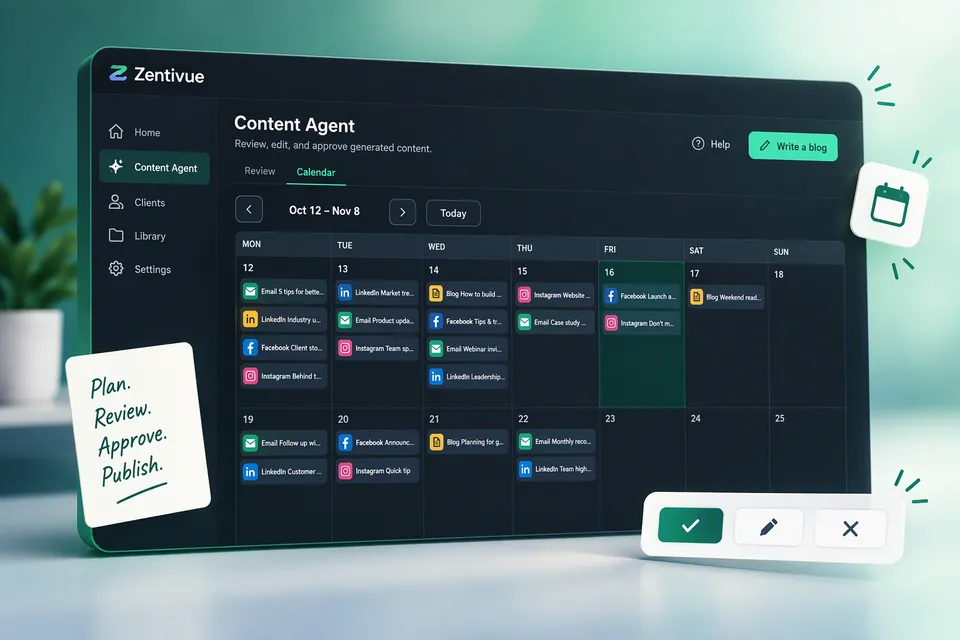
In Zentivue, each client's posts per week are set channel by channel, and a channel set to zero is switched off. Each week Zentivue prepares that many drafts for every client before the week begins, dated for the posting days you chose. If a campaign or an unplanned announcement needs more, you can generate extra drafts at any time.
Plans are sized by the number of clients you manage and how often they post on average, as a guideline rather than a hard limit. If a few clients post more than average, an extra credit pack covers the busy month without changing plan. See the pricing page for plan sizes, or how Zentivue works for social media managers with many clients.