

The settings Zentivue started from
- Channels
- LinkedIn, 3 posts a week; X, 2 posts a week; blog, 1 article a week. Drafts suggested for Monday, Wednesday and Thursday.
- Voice
- CFO.
- Tone
- Formal or casual: mostly formal. Serious or playful: serious. Reserved or bold: balanced.
- Business description
- A one-person fractional CFO practice for founder-led companies with roughly 10 to 80 employees. It sets up monthly reporting, cash-flow forecasting and pricing reviews, and prepares owners for conversations with banks and investors. Clients get finance leadership a few days a month without hiring a full-time CFO, and decisions based on numbers they understand.
- Post types
- Educational 50%, Marketing-Sales 30%, Promotional 10%, Product 10%.
- Core topics
- 13-week cash-flow forecasts; pricing and margins; monthly reporting for owners; preparing for a bank conversation; when to hire a finance lead.
- Topics to avoid
- Tax advice; specific investment advice; named clients; market predictions.
- Words to use and avoid
- Use: cash flow, margin, forecast. Avoid: synergy, guru, hack.
- Hashtags, emoji and exclamation marks
- #CashFlow #FractionalCFO #SmallBusinessFinance. Emoji: none. Exclamation marks: none.
- Images
- Calm, minimal office scenes, notebooks and simple charts on paper, soft daylight. Never show: people's faces, stock-market tickers. Short headlines allowed in images. The practice's logo is shown in images.
The week's drafts
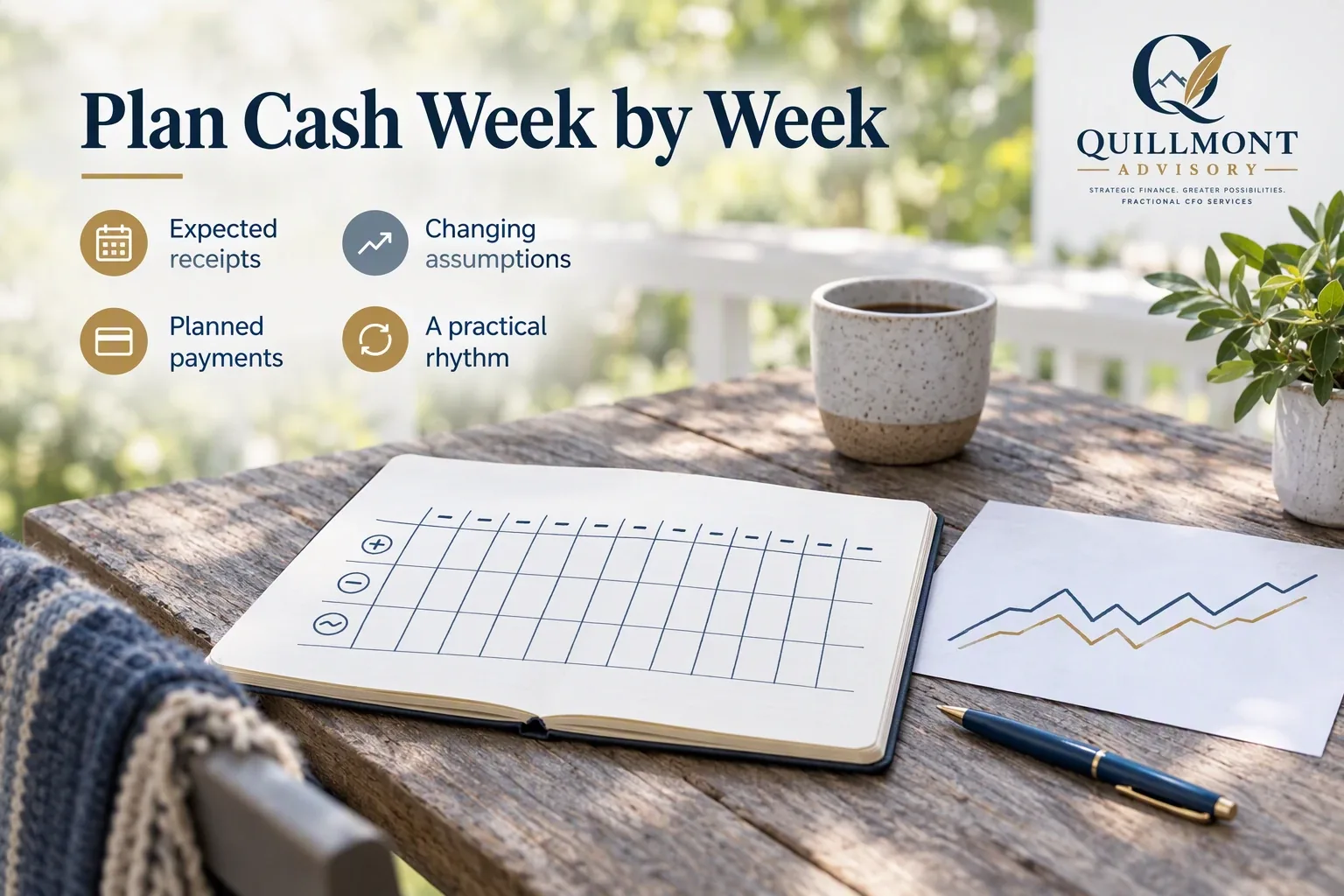
13-Week Cash Flow Forecast as a Weekly Operating Guide
A 13-week cash flow forecast is not valuable because it predicts every dollar perfectly. It is valuable because it gives an owner a clear view of what may need attention before a cash shortfall becomes urgent. The goal is a working guide for the next few months: what cash is expected to arrive, what cash is committed to leave, and which decisions could change the picture.
For a growing company, that view is often more useful than a year-end financial statement alone. A profit on paper does not automatically mean cash is available for payroll, supplier payments, inventory, or a planned hire. A weekly forecast brings timing into the conversation.
Start with the opening cash position
Every weekly forecast needs a reliable starting point. Use the cash actually available to the business at the beginning of the first week, rather than an old account balance or a number from a prior report. If cash is held across more than one operating account, include each account that is genuinely available for business needs.
Then organize the forecast into weekly columns. Thirteen weeks is long enough to reveal a developing pressure point, but close enough that management can act on the information. For each week, the basic structure is straightforward:
- Opening cash balance
- Expected customer receipts
- Other expected cash inflows
- Planned cash outflows
- Net movement in cash
- Closing cash balance
The closing balance for one week becomes the opening balance for the next. That simple link matters. It shows how an earlier delay, unexpected payment, or large receipt can affect every week that follows.
Forecast receipts by timing, not optimism
The most common weakness in a cash flow forecast is treating invoiced revenue as though it were already in the bank. A sales invoice may be valid, a customer relationship may be strong, and payment may still arrive later than expected. The forecast should reflect when payment is likely to clear, not merely when work was completed.
Review open invoices one by one when they are material to the business. Consider the agreed payment date, the customer’s recent payment pattern, whether the invoice has been sent correctly, and whether anyone is actively following up. It is often useful to distinguish between receipts that are highly likely, receipts that are possible but uncertain, and future sales that have not yet been invoiced.
For recurring revenue, use the actual billing and collection rhythm. For project work, connect expected receipts to a clear milestone or invoice date. This is not about making the forecast pessimistic. It is about making uncertainty visible, so an owner can decide what needs follow-up.
List outflows when they will be paid
Cash leaves a company on its own schedule. Payroll, rent, supplier payments, software subscriptions, loan payments, and larger one-time purchases can create a difficult week even when the month as a whole appears manageable. Put each payment into the week it is expected to leave the account.
Regular expenses can be grouped when their timing is predictable. Larger or less frequent items deserve their own line. That makes the forecast easier to scan and helps prevent a significant payment from being buried in a general expense category.
It also helps to separate commitments from choices. Payroll and contractual payments may have little flexibility. A discretionary purchase, an extra marketing spend, or a replacement asset may be worth making, but it should be identified as a decision rather than treated as an unavoidable surprise. The distinction gives the owner more room to prioritize.
Use the forecast to test decisions
A forecast should answer practical questions, not just produce a closing balance. Once the weekly view is in place, test the decisions currently on the table. What happens if a major customer pays later than expected? What if a planned supplier order moves forward? What if a role needs to be filled before the next billing cycle?
These questions do not require elaborate models. A small number of clear scenarios can be enough to show where the business has flexibility and where it does not. The point is to understand the consequence before a commitment is made.
Pricing deserves attention here as well. A sale that appears attractive can still place pressure on cash if delivery requires substantial upfront labor, materials, or outside costs. Looking at the timing of those costs alongside expected collection helps an owner assess whether the work supports cash flow. Reviewing the margin on the work adds another useful perspective: a deal that brings in cash quickly may still deserve a closer look if it does not contribute enough after direct costs.
A useful forecast does not eliminate uncertainty. It turns uncertainty into questions that can be managed.
Set a weekly review rhythm
The value of a 13-week forecast comes from maintaining it. Set aside a regular time each week to compare the prior forecast with what actually happened, update the opening cash balance, remove payments that have cleared, and add newly known receipts or obligations.
When a number changes, record why. Perhaps a customer payment slipped, a supplier required an earlier deposit, or payroll was different from the initial expectation. Over time, these notes reveal which assumptions are consistently reliable and which need more caution.
A useful weekly review can focus on a short set of questions:
- What receipts were expected but did not arrive?
- What payments are now due sooner than planned?
- Which upcoming weeks show the lowest cash balance?
- What actions could improve the outlook or protect available cash?
The review does not need to be lengthy. What matters is that it occurs before the next week’s decisions are fixed.
Make the next decision clearer
Every founder-led company has its own collection cycle, payment commitments, and growth plans. The right forecast is therefore not the most complicated one. It is the one that reflects the business’s real timing and helps the owner see the next decision more clearly.
Start with the cash you have, the payments you reasonably expect, and the obligations already in view. Update the forecast weekly, challenge assumptions that no longer fit, and watch for the weeks where a small change could have an outsized effect. That discipline makes cash flow a managed part of the operating rhythm rather than a problem discovered too late.

When a healthy price masks a thin margin
Your price can look healthy while each sale quietly weakens cash flow.
We review the margin, cost assumptions and forecast behind it, so founders can set prices using numbers they understand. #CashFlow #FractionalCFO

The early-warning value of a 13-week view
Cash flow trouble rarely starts when the bank balance dips.
A 13-week forecast helps owners see when payroll, supplier payments, and margin pressure converge—early enough to choose the next move with clarity.
#CashFlow #SmallBusinessFinance

The Question Monthly Reporting Should Answer
An owner’s monthly report should answer one question before it creates ten more: what needs attention now?
A useful reporting pack does not begin and end with a profit-and-loss statement. It connects operating decisions to three practical views: cash flow, margin, and the forecast.
Start by comparing the month with the prior period, not to admire a variance but to understand it. Did a change in customer mix affect margin? Did completed work differ from invoices issued? Did a one-time payment change cash flow without changing underlying performance?
Then carry those observations forward. A forecast becomes more useful when its assumptions are visible: expected receipts, planned spending, staffing changes, and the decisions that could alter them.
The goal is not more pages. It is a monthly rhythm that helps an owner find the question worth pursuing while there is still time to act.
When you review monthly results, which question do you wish your reporting answered more clearly?
#CashFlow #FractionalCFO #SmallBusinessFinance #MonthlyReporting #BusinessFinance
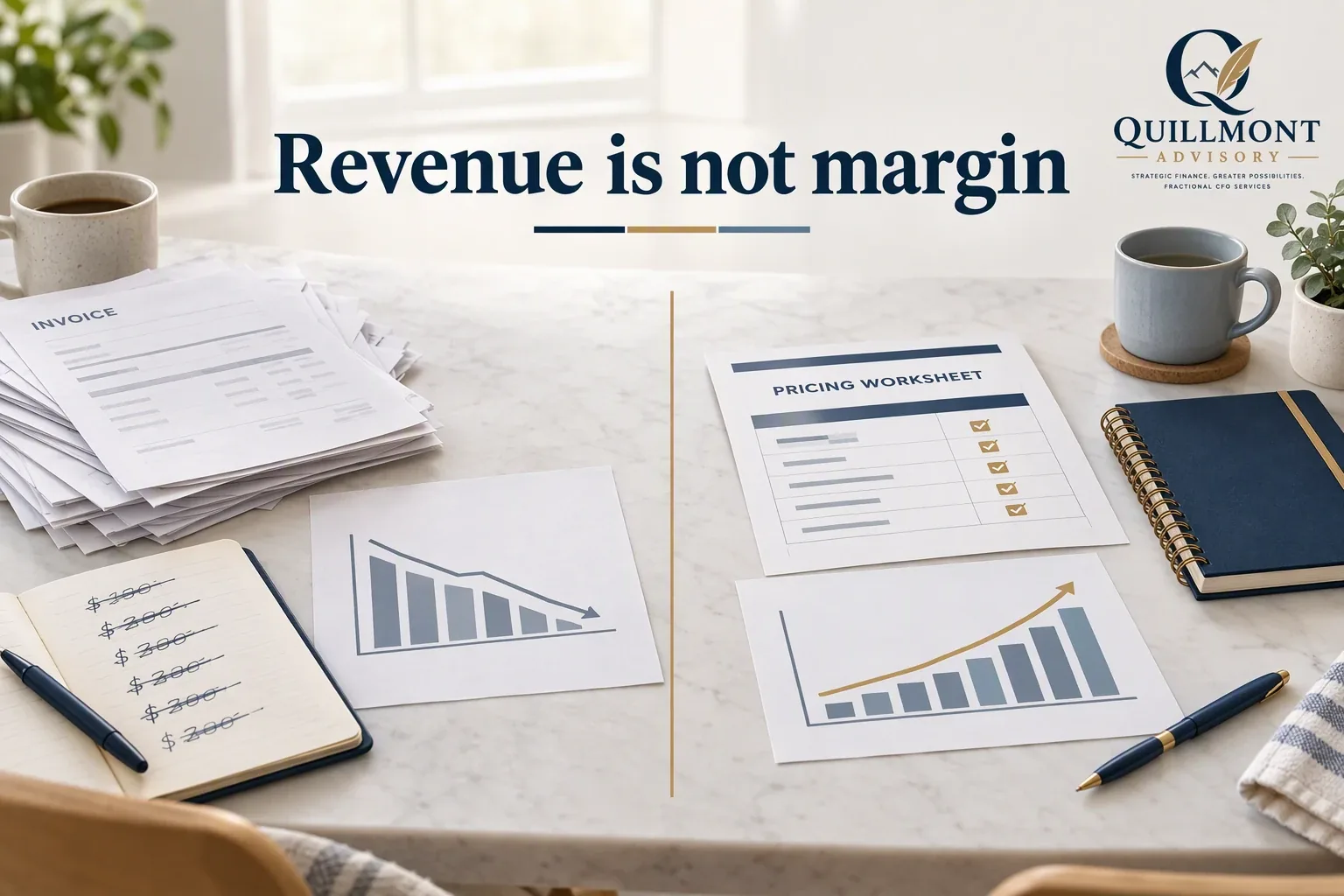
Revenue Can Hide a Pricing Problem
A busy month can still leave an owner wondering why there is so little room in the bank account.
That is often not a sales problem. It is a pricing and margin visibility problem.
When pricing decisions are made customer by customer, it becomes difficult to see which work is carrying the business and which work is consuming time, delivery capacity, and cash flow. Revenue may look encouraging while the underlying margin tells a different story.
A useful review does not need to become an academic exercise. Start with the work you sell most often: what it costs to deliver, what support it requires, and what remains after those commitments are covered. Then connect those findings to the cash flow forecast.
This is where finance leadership can create clarity. We help founder-led teams turn monthly reporting into practical pricing conversations, so owners can decide what to protect, adjust, or stop offering before pressure builds.
Where would clearer margin visibility change a decision in your business?
#CashFlow #FractionalCFO #SmallBusinessFinance #PricingStrategy #ProfitMargins

A Forecast Should Trigger Decisions
A cash-flow forecast is not useful because it fills 13 columns. It is useful because it shows where a decision may be waiting.
When an owner reviews the weeks ahead, the key question is not simply, “Will cash go down?” It is, “What would we do if this happens?”
A practical forecast can surface conversations early: whether customer collections need attention, whether a planned purchase can wait, or whether a pricing decision is protecting enough margin. These are operating choices, not just finance tasks.
The value is in revisiting the forecast as new information arrives. A delayed payment, a changed sales expectation, or an unplanned expense can alter the path. Updating the view creates time to respond deliberately rather than react under pressure.
A forecast should leave an owner with a short list of decisions to watch, not a spreadsheet to admire.
What decision would you want more warning about in your cash flow?
#CashFlow #FractionalCFO #SmallBusinessFinance #FinancialPlanning
Every draft above was generated by Zentivue and reviewed in Zentivue. X drafts are written to X's 280-character limit. See how a week works, or compare plans.